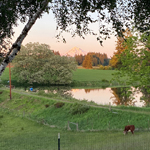
Oh, we did have fun, Audrey and I. We walked all around our little neighborhood yesterday, checking things out. It was pretty sleepy-quiet out there, just the way we like it. This is our neighbor's dappled driveway. I love scenes like this. All these photos are of things a few blocks from our place.
 One of my least favorite and most-lingering effects of being run over by a truck has been losing the ability to walk around the neighborhood the way I used to. As a child and teenager and even when I lived there for a couple of years after college, I walked every inch of my hometown. I had skipped, ridden, galloped, sauntered, slapped my way down Forest Avenue a million times, probably two million. I did not own a car until I was thirty years old. I walked everywhere, in every kind of weather, like a mailman. One snowy, cold afternoon, my next-door neighbor, that lovely, soft-spoken, grandfatherly Irishman Joe May was pulling out of his driveway and saw me walking to work (two miles away), asked if I wanted a ride. Oh no, I replied, cheerily. I have plenty of time. He shook his head, chuckling, and said, "You are crazy. Beautiful, but crazy." It was one of the best moments of my whole life. I mean, I already knew I was crazy. I didn't know about the other thing. I was warmed all the way across town.
 When I was growing up, I spent a lot of time out of my own house, dreaming of other houses. I didn't know that I lived in a special town. This was Oak Park (and River Forest), Illinois, home of Frank Lloyd Wright and dozens of his houses; they litter the place like exotic butterflies, but your friends live in them, they're just places you walk past on your way everywhere, school, the library, the bakery. I mean, it's completely outrageous, how pretty those houses are, how magical those streets. In my pedestrian travels around OPRF, I noticed every yard, every front porch, every flower planter, every lightpost, and took copious mental notes. In my anxiousness to escape my own and live in any other house, I bundled parts and pieces of all the houses that I saw and created imaginary ones of my own; my fantasy houses were sophisticated and extreme, filled with dumbwaiters and Prairie-Style great rooms and carriage houses in back gardens, and trees growing straight up through living rooms.
 I know that working on these "houses" saved my life, for I did feel that I was working as I was walking. I knew, I just knew, there could be a better way, that spaces could change everything, that someday I would be old and get to leave and be in charge of atmosphere. I would not let anyone smoke in my house. I would make people go to bed at regular times, and there would be nice sheets. I would never, ever have blinds closed during the day. I would give everyone a little table of their very own, at which to do whatever kinds of things they wanted. I would actually care if the residents of my house were unhappy.
 I'm all grown up now, and have my own dear little house. It certainly doesn't have a dumbwaiter — it doesn't even have a garbage disposal — but it is very happy. I knew it could be, and I was right, I was so right. Your space can change your life. I still love looking at houses, though. Our little neighborhood in Portland, where these pictures are from, is a mix of big old houses and squatty little cubes and overblown gardens and dried-up yellow lawns. It's full of working families and shared driveways and shabby apple trees that drop their gloppy packages on the sidewalk, and nobody, including us, bothers to clean the stuff up. There are gargantuan roses and vegetable gardens planted in front yards and sagging moss-covered roofs and peeling paint and entire sun-blasted streets where the tree trunks are only four or five inches around. And there are streets with big old oaks that make me feel like I'm back home.
 These are the first pictures I've ever taken around my neighborhood, for some reason, though this is our familiar dogwalk route. That brick house up there is my favorite. It actually doesn't fit in the neighborhood at all, I don't think — it's much too fancy and well-kept for our crowd. I drive past it every couple of days to see if they've put a "for sale" sign out front. I've told Andy that the minute they do I'll sell everything I have in order to get it. It's a joke, of course; we could never afford that beauty. But I do like to go by and say hello to her when I can. I think she's just lovely.
 God, I miss walking. It's a different experience now, with the crap foot. It's like the walking itself, the steps are the real thing, because they hurt and you feel them. Before, the walking was nothing, automatic in that way; I never thought about the action itself. It was the invisible vehicle that allowed me close access to the houses, and gave me time to think. And now the houses are sort of there, but they're secondary to me counting steps in my mind — how much farther can I go before I need to turn back. You must stop when you've reached the halfway mark, because the way back makes up the second half of the steps you get to take. But, whatever. That's life. You can't stop walking, even if it's not the same. But oh! the luxury of the un-noticed, un-felt step!
 I think about the people displaced by Hurricane Katrina, all those suffering war and dire trouble, soldiers in bunkers, children in unhappy homes, refugees without places to rest, and I feel such panic on their behalf. Sometimes when I'm out and I've walked too far, and am worried about whether my foot will make it back home, I think of them: that feeling of being caught out in elements, at the mercy of the home-ful, dependent, out of place, trying to get back, looking in every glowing window and knowing it is not your own, the flickering room on the other side as far away, as untenable, as the sun, all forms of warmth and comfort.
 When I was eleven I loved a book called My Side of the Mountain, about a boy who runs away and lives in a hollowed out tree with a pet falcon. I read it over and over again. That same winter my dad and I found a little hand-built house in our urban forest preserve, hidden by snow in a grove. Someone was living there, just like the Boxcar Children, though this was a very professional, survivalist arrangement. He said the person was probably in the snowy trees, hiding only feet away, watching us, though we never saw anyone. I've never forgotten it. Often I would walk down my street in the winter, at quiet twilight, with all those black branches against that white, white sky, and I'd think about the street when it had been just forest, when Indians lived there and padded the deer trails with their hushed, moccasin-ed footfalls, tracking. Somewhere in my trunk of things downstairs in the basement is a notebook with my notes about how I'll do it, how I'll build my own little mudhouse, use a tin can for a chimney, should the need ever arise.