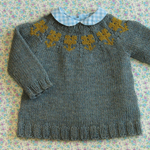
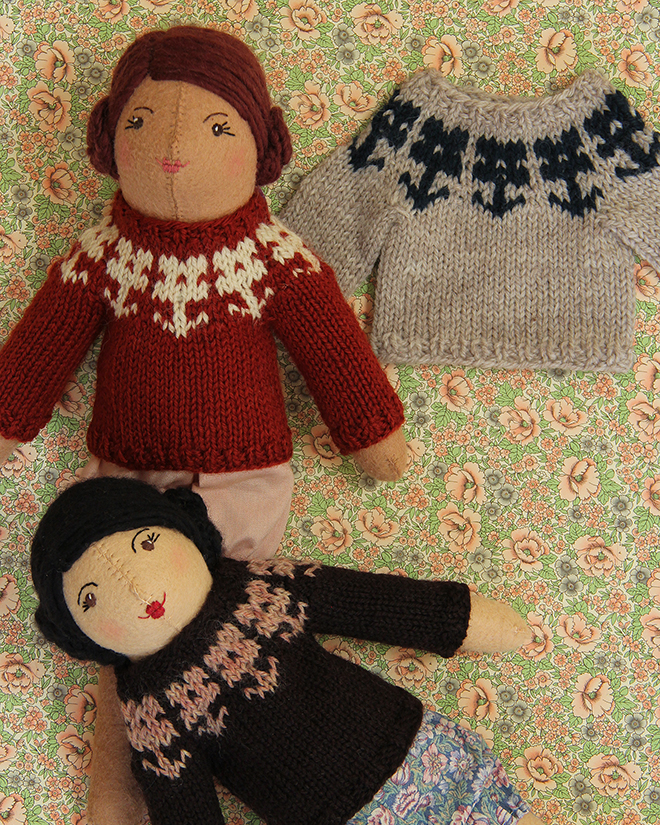
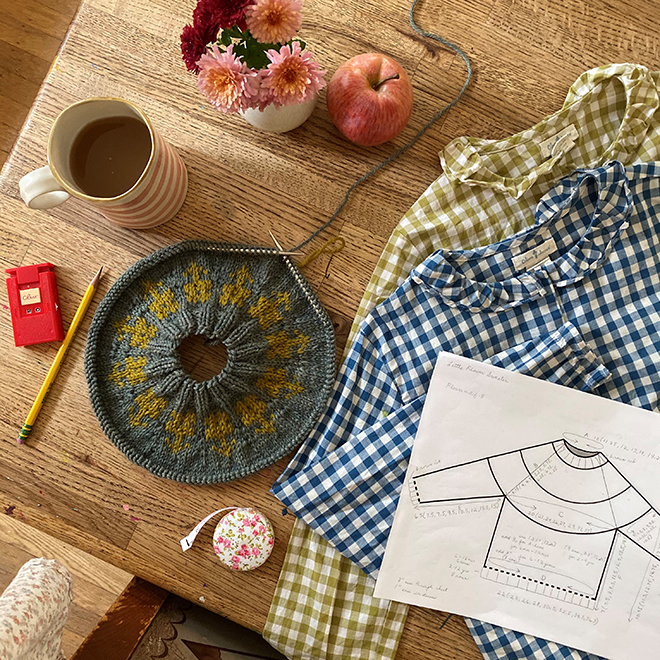
I'm swatching yarn samples like crazy, trying to decide what yarn to use for my little kid sweaters. The doll sweaters use Nature Spun Sport. I wanted something slightly heavier for the kid sweaters but I wanted it to feel the same-ish. Right now I'm leaning heavily toward using Cascade 220. Huge palette of colors, light worsted—/DK-weight. It has the kind of halo I like, and the "yarniness" I like — I liked plied yarns without a ton of twist, and I like yarns that aren't too smooth and round. Just round enough. It feels old-fashioned and rustic-y, but it really softens after blocking and it is durable. It's affordable and very readily available, and this was really important to me. Downside, it’s made in China. :(. Originally I was totally going to use acrylic for these, but it just was not working for me, no matter what I did. It just wasn't make me happy when doing colorwork. It just wasn't giving and stretching the way it needed to. As soon as I switched back to wool it was just like . . . yep. There's a superwash 220, too. I'm getting the same gauge for the superwash and the regular, which is apparently a bit unusual, as the superwash is supposedly lighter. I'll do samples in both, just to see.
This brought up a conversation at the yarn store yesterday. When you knit a pattern, do you use the yarn that is suggested? Do you just go to your own personal favorite? How much does the yarn used by the designer influence you? Can you see past that if you don't like it, or is it a major factor in whether you can visualize your project? Do you just go to the store and pick something out and then try to find a pattern for it? Tell me everything. I'm really curious about this now. I almost never use the yarn that's recommended. I have no idea why. Rebel.
***By the way, for you non-knitters, "swatching" is the process of working up a little 4"-square sample of knitted yarn, generally in the stitch pattern the design calls for, to see exactly how many stitches you get per inch, and how many rows you get per inch. This is your "gauge." All patterns should have a gauge, and it is super important. One stitch short on a 4" gauge swatch can add up to being several inches off on your finished piece, so it really matters. Number of stitches across is more important to match; matching rows can be trickier. Usually patterns will tell you how many rows (or rounds) to knit and also give you the length in inches and centimeters you are aiming for (on a yoke, sleeve, or body, or an amount of ribbing, etc.). If you know how to knit and you've heard about gauge but you still think it's kind of confusing (I did, too, when I was first learning), leave me questions and I will answer them. And also by the way, if you are interested in writing knitting patterns, The Beginner's Guide to Writing Knitting Patterns by Kate Atherley is excellent. I highly recommend it.