Posts filed in: Fabric and Sewing

An Oregon Summer Quilt

comments: 51

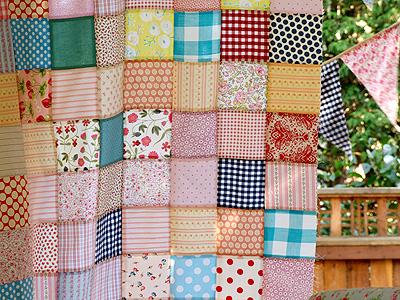
OregonSummerQuilt2

Coming together nicely (even if I did spend all day at the pool yesterday — oops).

OregonSummerQuilt3

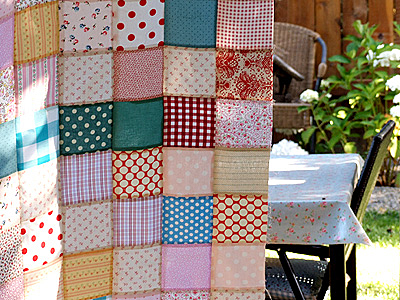
24 by 28 patches, each 3.5" square when finished.

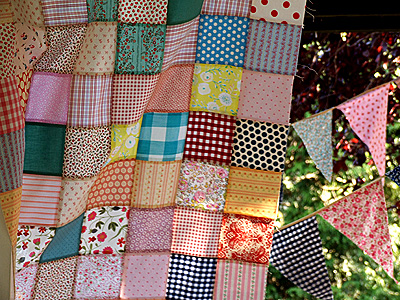
OregonSummerQuilt4

I hang it on the curtain rod over my sliding door while I'm working on it because I like the way the light looks when it shines through.

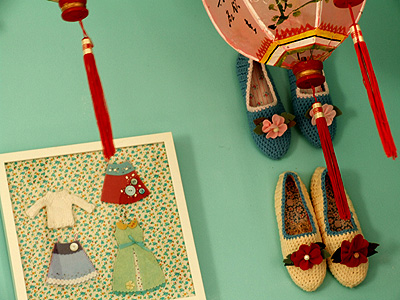
Studio1

Get ready to say goodbye to this color. It was fun while it lasted but I am very ready for something else. (Paint, lantern, and slipper info on my FAQ page.)

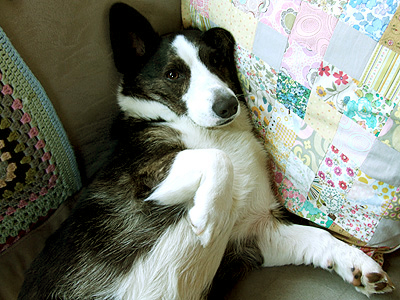
SleepyDog1

Oh sweet dog. She stayed in this exact position for about ten minutes. It reminded me of playing Statue when I was a kid. She's so dang sweet. Her little leathery nose. It's the perfect temperature of cold on a hot day. Mwah mwah mwah. Love you so much, Clover M. You make me laugh every day.

Calico Blossom Fever

comments: 82

Hexes3

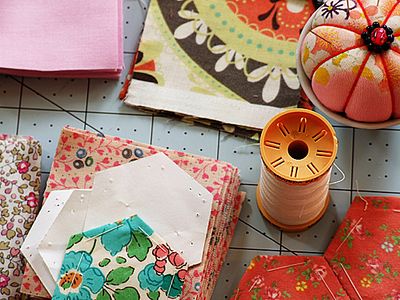
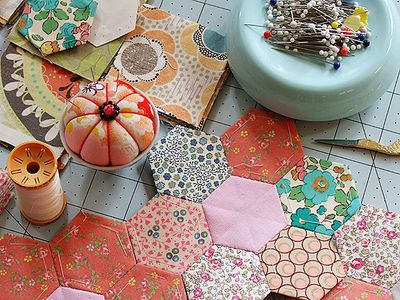
Many hexes! Yes, we're still here on the hexes. It's true that once you start you'd better settle in, 'cause you can't stop. Well, scratch that — you'll stop once you get a tender makings of a callous on your finger (if you're one of those people, like me, who can't use a thimble but prefer to sew through the papers, and not just baste the seam allowances at each corner) and that's probably a good sign, anyway, that you should get up and go outside. I was getting over my cold and didn't feel like doing anything, so it was good medicine.

Hexes4

Also, I was just liking these colors together: milky blues, apricots, Bellini peaches, lilac-y pinks. The weensy pincushion was a gift from my friend Aimee who is the stylist at Cargo — you might still be able to get one there, I don't know.

Hexes5

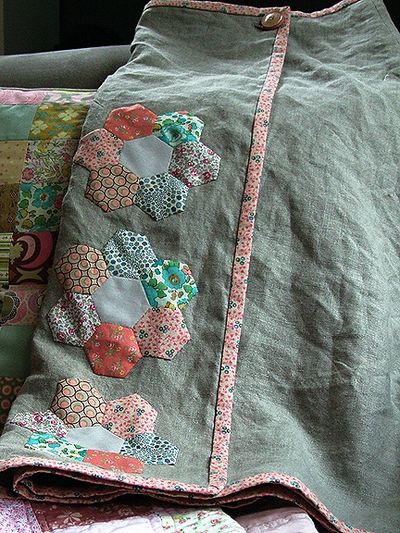
I'm still not sure what I will do with all of them, ultimately. I did put a few on the wrap skirt I whipped up (same as these). I've been kind of a hand-binding machine lately. In the past few weeks, I've finished binding two quilts (one was little, granted) and a wrap skirt by hand. Then I hand-appliqued three of the blossoms to the skirt. Wore it to the bagel shop and had a chicken-salad sandwich. Yes, that's as exciting as my life has been lately.

WrapSkirt1

Thrillsville.

Hexagon Piecing

comments: 104

Hexagons9

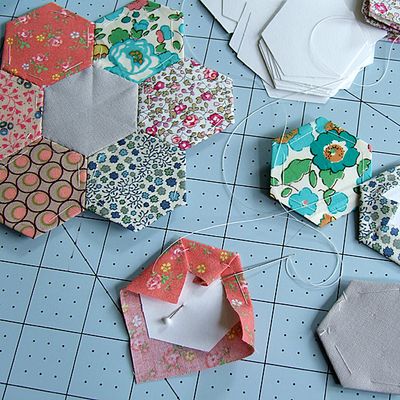
Oooooh, I had a feeling. I had a feeling these would be addictive. I've wanted to do this — English paper piecing — for a while but I wasn't sure I could handle another distraction. I'm still not sure I can handle it, but let's just say I am completely distracted now.

Before I go on in this direction, I will say that I did finish Arden's quilt already. I just need to photograph it. So I am, at least, a little bit collected. I'm about to go into a collected trot here, to use a horsey term. A collected hexagonal trot.

Here's how you do this: Get a whole bunch of hexagon papers (do yourself a favor and splurge on these already die-cut heavyweights. Mine were $19.00 for 600 1"- [2.5cm-] sided hexagons, and they are totally reusable, so to me, this is a purchase that is well-worth the money, since your wrist will already be getting enough of a workout without having to cut out all of those hexes yourself). Then cut a whole bunch of 2 1/2" (63mm) squares of your favorite quilting cottons with a rotary cutter, self-healing cutting mat, and clear plastic ruler. (If you want to make a different-sized hex, the size of your square will vary relative to the size of the hex; a chart to help yo determine how big to cut your squares is here.) Then get a straight pin, a sharp, hand-sewing needle, and some cotton thread (the same stuff you'd use in your sewing machine).  Pin the hex to the wrong side of the squa, fold the fabric over each edge of the hex, and baste (through the paper) in place. I tied knots on the front sides of the hex in both the beginning and the ends of the basting thread because it is easy to (after the hex is stitched to six other hexes) remove the basting thread from the front by clipping each stitch and pulling on the knots.
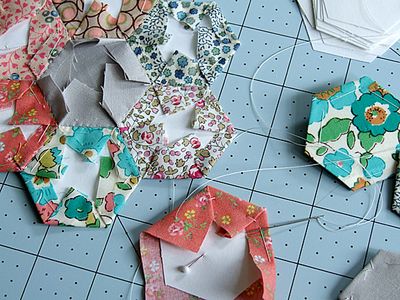
Hexagons10

Many tutorials that I found on-line and in some old books that I have want you to trim the fabric into a hex, leaving a 1/4" (6mm) seam allowance, but that seems like extra work, and if the Paper Pieces peeps say you don't have to, I believe them. Wrapping full squares worked just fine for me. To stitch two hexes together, just place them with their right sides together and whipstitch along the top edge, being careful not to stitch through the paper — just grab a few threads from each hex and make small, even stitches.

Hexagons11

I stitched twice through each corner and knotted at each end. I'm sure there's a way to carry your thread around to stitch each seam of the hex (to another hex), but that proved to be too much for my addled brain to manage, so I just finished off every seam before starting the next. Here's another view of one seam, kind of tilted open:

Hexagons12 

To make a flower, I stitched all of the hexes to the center hex, then once all six sides of any hex are attached to other hexes, you can clip the basting stitches and take the paper out. This allows you to fold that center hex, making it easy to stitch the sides of the other hexes together to form the petals.

This is not sewing for the faint of heart — when I was at Fabric Depot buying the hexagon papers, I was asked by the saleslady what my pain threshold was, and I answered emphatically, "High!" (And by the way, my cutting mat, pin holder, and most of my tiny calicos come from Fabric Depot, though I have an enormous stash of calicos, collected over twenty years, so a lot of fabrics that you see me use come just from my own shelves. I have been getting a lot of questions about fabric lately, so I will do a whole post about that soon, and give you some great local sources when my head is more unstuffed.) Sewing hexes takes some precision and patience, but if you have those tendencies (and I would say I do, generally, unless it really doesn't matter, and then I don't), you will like these. I think this is a nice tutorial that will get you started on a little placemat and doesn't make things more complicated than necessary.

I still haven't decided exactly what I will do with mine, though I have a few ideas. One is to stitch at least a few of them to a oatmeal-linen wrap skirt that I bound the edges of with one of the fabrics that's in the hexes. There's also potholders, bags, placemats, pillows, stuff like that. Another idea is to make little collections of similar flowers and then cluster them together in random groups, and then cluster the random groups together, and then applique the whole big cluster to a whole cloth, either a runner, or a tablecloth, or maybe even a quilt. That would be a seriously massive project. I don't know if my pain threshold is that high. It's high, but I don't know if it's that high. I only have five flowers done, so perhaps I am getting ahead of myself.

Rainy-Day Runner

comments: 47

Runner1

It's a commitment. It's not for the hand-sewing faint-hearted. But look how pretty. My Purl Bee Runner is underway. I am very pleased. By late afternoon, I'd made some chai and had stitched eight of the twenty-two squares to the backing fabric. Luckily, I love to slipstitch. You'll get good at it here. Twenty-two for the runner (I made my shorter than theirs) and eight for the napkins (later).

Runner2

To make the runner (and napkins), you back the fabric squares with pieces of fusible interfacing, then slit the interfacing and turn the square, pressing it into place on the backing fabric. The fusible web helps hold the square in place while you applique it. It's a nice method, though my linen was so heavy (like, really thick and heavy) the web didn't want to stick that much. But it was enough. A trick for pressing down the outside edges of the square, where there are a couple of layers of fabric to heat through: Press the backing fabric around the edge of the square first, then press the square down on top of it. That will heat up the fusible web from below, and melt it together. Do this quickly, one side at a time, so the fabric stays hot.

Runner3

There is a reason the Purl ladies did this as a quilting bee — it's a lot of sewing, and besides, how fun would this be to make together? (very) — but I have only a warm, sofa-hogging dog so I have to do mine myself, with a dog head in my lap. Plus there's no more room on this sofa. Have I mentioned before about my cuddly dog?

Runner4

Yes. I think I have. The goal of this dog's life is, apparently, to lay with her head in my lap. Or her chin on my ankles. Or her paws on my thighs. Occasionally she looks up at me adoringly and pushes her suede nose into my hand, and then I put my work down and scratch her bunny-soft forehead. For a long time. Oh, Clover Meadow. You are aptly named. I've never met a dog as sweet and gentle, as beckoning and full of sunshine as you.

Runner5

In the late afternoon, as we watch the leaves blow away, and the rain start to fall, this is pretty much what we do.

(It's kind of hard to take pictures of a dog on your own lap, I have to say. The camera happened to be on the tripod just a couple of feet away, so I pulled it over and sort of pointed it down at what I thought it should look at, and set the timer, but I couldn't ever see the viewfinder. After a few shots, the battery died, but who would want to move from here to go get more. Not her. Even less, me.)

About Alicia Paulson

About

My name is Alicia Paulson
and I love to make things. I live with my husband and daughter in Portland, Oregon, and design sewing, embroidery, knitting, and crochet patterns. See more about me at aliciapaulson.com

Archives